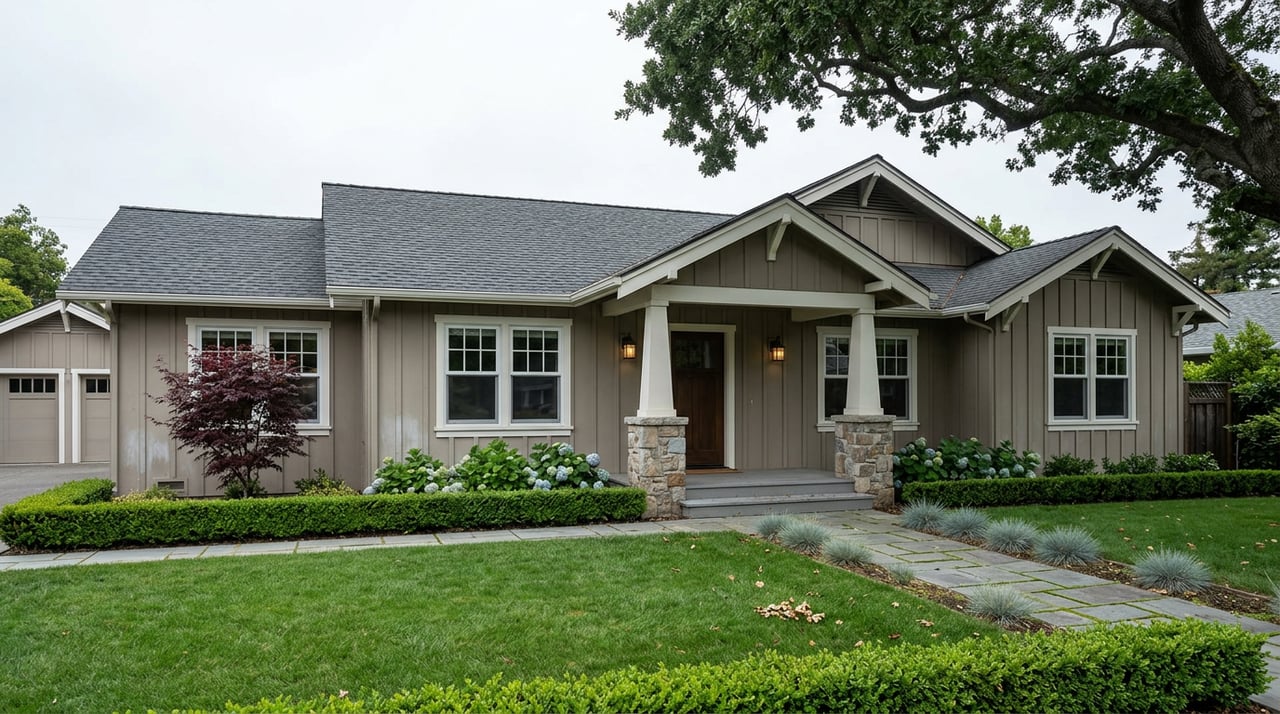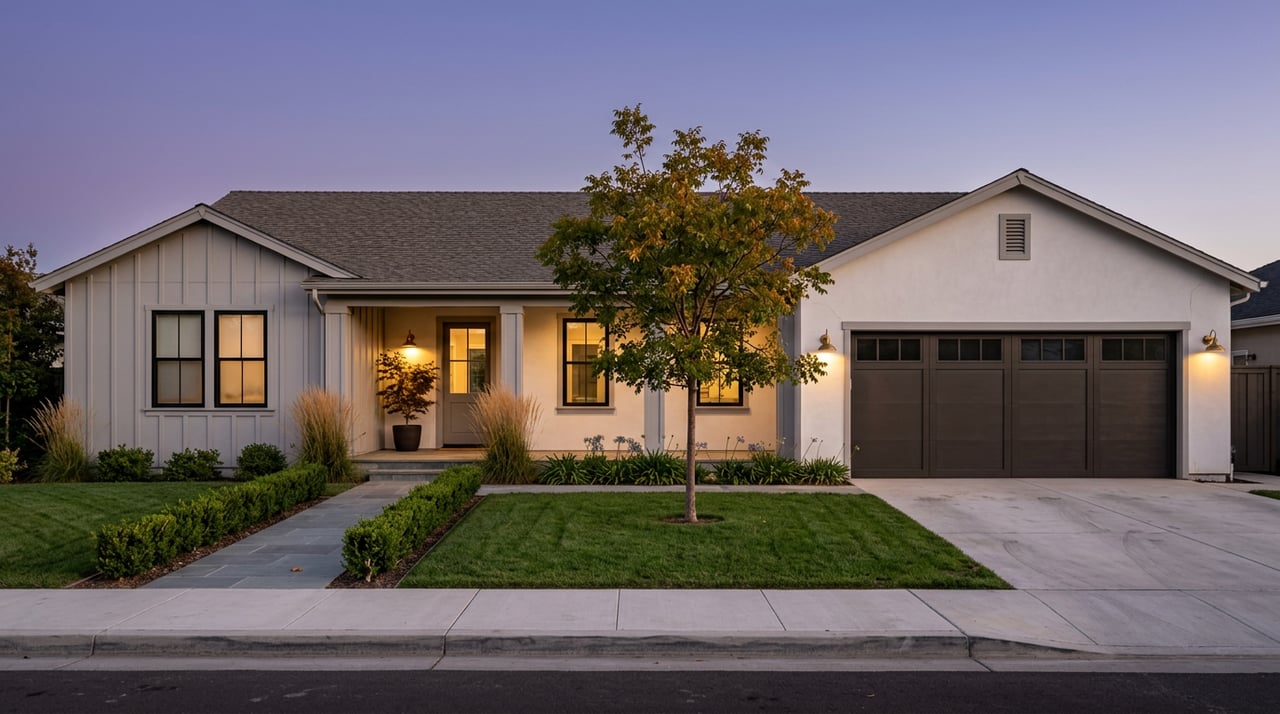
A house in Windemere sold at a median of $1.9 million in January 2026, up 10.2 percent from a year earlier. A few miles away, brand-new homes going up inside Bishop Ranch, on land that was an all-office corporate campus until a few years ago, are currently listing closer to $1.4 million. Both are San Ramon addresses. They are not the same market.
If you've been comparing San Ramon to Dublin or Pleasanton using a single citywide median, you've been comparing an average of two things that are moving in opposite directions for entirely different reasons. One is a scarcity story. The other is a construction schedule. Mixing them together produces a number that's technically accurate and practically useless for figuring out what your money buys.
The Median Is Measuring Two Different Cities
Pull San Ramon's median home price from four different sources this summer and you'll get four different answers: a three-month median near $1.6 million through May 2026, a citywide average near $1.54 million as of late June, a January reading closer to $1.3 million, and a May 2026 median around $1.4 million. Analysts covering the city have described this as a market where luxury pockets are holding firm while the broader median compresses, and the divergence is wide enough that it shows up as noise across every major data source rather than a clean trend line.
That spread isn't sloppy data. It's what happens when a city is quietly running two housing markets at once. San Ramon's established hillside neighborhoods are trading a fixed, aging supply of resale homes. Its Bishop Ranch district is in the middle of adding thousands of brand-new units on a twenty-year build schedule. Blend those two datasets into a single citywide median and you get a number that moves for reasons that have nothing to do with whether any specific comparable home gained or lost value.
How Bishop Ranch Became a Second Downtown
To understand why, you need to know what Bishop Ranch actually is. It's not a subdivision. It's a 600-acre, six-million-square-foot corporate campus that Sunset Development has owned and operated since 1978, home to roughly 25,000 employees across more than 400 companies. For decades it was purely commercial: office towers, parking structures, a business park built for the workday and empty by evening.
That changed with the arrival of City Center Bishop Ranch, a 300,000-square-foot retail and entertainment district designed by Renzo Piano, the Pritzker Prize-winning architect behind the California Academy of Sciences and the Whitney Museum. City Center opened anchored by THE LOT's ten-screen luxury cinema and an Equinox fitness club, and it filled in with restaurants like The Slanted Door, LB Steak, and Fieldwork Brewing alongside retailers including Anthropologie and Pottery Barn. A weekly farmers market runs on Saturdays. The project became the largest shopping center in the world to earn LEED Platinum certification, and it gave Bishop Ranch something an office park never had: a reason to be there after 6 p.m.
Once that foot traffic existed, Sunset Development started building the thing that traffic needed to sustain it. Homes.
Three New Neighborhoods, One Long Timeline
The first residential community inside Bishop Ranch, City Village, launched in 2023 with 404 homes built by SummerHill Homes: 268 detached houses and 136 attached townhomes, plus nine below-market-rate units allocated by lottery. Townhomes started at $1.1 million and detached homes at $1.5 million when sales opened. The community is now more than half sold, and SummerHill has since moved its sales office to a second phase on Twilight Terrace.
The second wave is larger and newer. In April 2026, San Ramon's City Council rejected an appeal and cleared the way for Orchards, a 144-acre project on the former Chevron campus that Sunset acquired in 2022 for $174.5 million. Orchards is approved for up to 2,600 homes, 125,000 square feet of retail, a 2.5-acre park, and a greenway connecting to the Iron Horse Trail, built out in phases over roughly two decades. The council meeting ran more than three hours, with resident Brian Swanson arguing the city's traffic analysis hadn't kept pace with what's already changed on Camino Ramon. The appeal failed, but the concern behind it is worth sitting with if you're weighing a purchase near the construction zone.
A third community, Canopy, is coming from national homebuilder Lennar on the former BR8 office site: 255 detached single-family homes across 25 acres, with demolition and construction expected to begin in mid-to-late 2027. The plan includes a five-block linear park with a pool, clubhouse, and dog area, and it's designed to link physically to both City Village and the neighboring CityWalk development.
Add it up and Bishop Ranch has roughly 1,000 homes built or underway against a stated plan for about 8,000 across the district, a figure that's actually been revised down from Sunset's original 2023 estimate of up to 10,000 units as specific projects like Orchards and Canopy have moved through entitlement. That's not a single subdivision closing out. It's a two-decade pipeline that keeps adding fresh, first-sale inventory to San Ramon's numbers every year for the foreseeable future.
What This Means If You're Comparing Neighborhoods
This is the part that changes how you should read a San Ramon listing. New construction inside Bishop Ranch and resale inventory in Windemere or Dougherty Valley aren't competing for the same buyer, and they don't behave like the same asset.
| Neighborhood | What's actually selling | Recent price signal | What's driving it |
|---|---|---|---|
| Windemere | Mostly resale homes, larger lots, no active builder pipeline | Median $1.9M in January 2026, up 10.2% year over year | Fixed supply, buyers competing for the same finite stock of existing homes |
| Dougherty Valley | Established homes near newer schools | Median $1.9M in January 2026, down 11.6% year over year | Still commanding a premium but decelerating faster than the hillside pockets as buyers grow more rate-sensitive |
| Bishop Ranch / City Village | New construction, HOA-governed, phased delivery from a single builder | Current new-construction listings near $1.4M | Price reflects whatever that year's builder phase is charging, not organic appreciation of existing homes |
Notice what that third row is actually saying. Bishop Ranch doesn't have much of a resale history to draw a median from yet, because nearly everything that's sold there so far is a builder's first-run inventory. As Orchards and Canopy add thousands more units over the next two decades, whatever price gets reported for that neighborhood will keep reflecting what SummerHill, Lennar, and Sunset Development decide to charge for that year's phase, not the appreciation of homes already owned. If you're using San Ramon's citywide median to gauge whether the market is heating up or cooling down, you're partly reading a construction release schedule, not a price trend.
The Friction Nobody Puts in the Listing
Buying into an active twenty-year build-out has real, practical differences from buying resale in an established pocket, and they rarely show up in the listing description.
Homes in City Village, and eventually Canopy and Orchards, carry HOA structures tied to shared parks, trails, and amenities that resale neighborhoods built in the 1980s and 90s often don't. That's a real monthly cost to underwrite, not just a line item to skim past.
Living adjacent to an active phase means construction traffic, staging equipment, and the kind of dust and noise that comes with any multi-year build, not for a season, but potentially for years as later phases break ground. The Orchards appeal made exactly this point publicly, and it's a fair one to ask about regardless of how the appeal was resolved.
Resale value in a still-building community is harder to benchmark. Comparable sales in Bishop Ranch right now are mostly other new-construction units from the same builder, priced by the developer rather than by the open market. That's a different valuation exercise than pulling three recent sales on your same Windemere street.
None of this makes Bishop Ranch a worse choice. For a buyer who wants walkable access to City Center's restaurants and the cinema, a lower entry price than the hillside neighborhoods, and a brand-new home with builder warranties, it can be exactly right. But it's a different product being sold at a different stage of its life cycle, and treating its price like a like-for-like comparison to Windemere or Dougherty Valley will lead you to the wrong conclusion in either direction.
Frequently Asked Questions
Is San Ramon's housing market cooling down or heating up? Both, depending on where you look. Established resale neighborhoods with limited new supply, like Windemere, have shown price resilience even as days on market stretch out. New-construction pockets inside Bishop Ranch are a separate question entirely, since their pricing is set by builders rolling out phases rather than by resale appreciation.
Will more of Bishop Ranch's residential build-out affect resale values nearby? It's reasonable to expect it will, though the direction depends on the phase and the timeline. A twenty-year build-out means new supply keeps entering the market gradually rather than all at once, which is a different dynamic than a single large development closing out in a year or two.
Should I wait until Orchards or Canopy are finished before buying nearby? That depends on your own timeline more than the construction schedule. Canopy isn't expected to break ground until mid-to-late 2027, and Orchards is planned as a twenty-year build-out, so waiting for either to be "done" isn't a realistic near-term strategy for most buyers.
If you're trying to figure out which San Ramon neighborhood actually fits what you're looking for, whether that's an established resale pocket in Windemere, a new build inside Bishop Ranch, or something in between, Sheryl Bursley can walk through the current inventory with you street by street and help you read the numbers for what they're really measuring.